Saturday, September 29, 2012

Thunder from the Sea: Adventure On Board the HMS Defender

Thunder from the Sea: Adventure On Board the HMS Defender
By: Jeff Weigel
Published by: G.P. Putnam's Son
Graphic Novel, Historical Fiction

Jack Hoynton is only a boy when he enlists in the Royal Navy and is assigned to the HMS Defender during the Napoleonic Wars. The ship is assigned to blockade a French port to keep the French from invading England.
On the ship, Jack has trouble with the tough work at first, but is taken under the wing of a sailor Hewitt. When the men run out of drinking water on the ship, they go ashore to find more, but are attacked by French troops and have to retreat to the boat. Jack's friend Hewitt gets left behind on shore and makes a deal with the French. He tells his fellow British sailors to come ashore to attack, but when they get there the French are waiting to attack them too! When they all get put in jail, Jack makes it his duty to escape from the jail and save his mates.
 
Reading Level:
     Grade Level: 2 and up
 
Suggested Delivery:
     Individual Read, Small Group Read
 
Electronic Resources:
This is the official website for the author of the story. There are many different links on the page to his other books, his artwork and a bio about him.
This site gives a brief overview of the Napoleonic Wars for children, including the different countries involved and what caused them.
This wikipedia page gives a full glossary of Nautical terms used in the book. Teachers or students can use this as a reference when reading the story.
 
Key Vocabulary:
Napoleonic Wars, Frigate, bosun, The Maritime Society, oakum, yardarm, shrouds, grog, starboard, schooner


Comprehension Strategies:

Before Reading:
Before reading the story, students will need some background information about the historical context of the story. A quick history lesson about the Napoleonic Wars would be advantageous to students. http://www.history.com/topics/napoleon This website gives a brief biography of Napolen Bonaparte and his rule. Students need to understand his rule and the reasons behind the wars in order to understand the historical content in the story.

During Reading:
Have students stop at points during the story to predict what will happen next. Students can write their prediction in a reader's journal or use a graphic organizer to organize their thoughts. There are many different points in the story where the tension rises and falls. Teachers can utilize these points to stop students in their reading to practice their comprehension skills in predicting.

After Reading:
After finishing the story, students can complete a writing assignment in which they change the story. Students must change an important turning point in the story and predict what would have happened next due to their change. What if Hewitt didn't get left on the island? What if Jack didn't escape the jail?

Writing Assignment:
The main character of the story is twelve years old, a close age to elementary students. Elementary students in the United States would not have similar experiences to Jack. For this reason, writing a journal entry from Jack's point of view would be a very different writing experience. Students would need to include nautical vocabulary and specific details from the story in their journals.

Weigel, Jeff. Thunder from the sea: adventure on board the HMS Defender. New York, NY: G.P. Putnam's Sons, 2010. Print.

Tuesday, September 25, 2012

Bud Not Buddy

Bud Not Buddy
By: Christopher Paul Curtis
Published by: Delacorte Press
2000 Newberry Medal Winner
 
Bud Not Buddy is the story of a young orphan boy growing up in the Great Depression. Bud lives in an orphanage and then is moved to a foster home where he is forced to sleep in a shed. Bud escapes from the foster home and begins his journey to find Herman E. Calloway, the man who he believes is his father. Mr. Calloway is a traveling musician who Bud has flyers about. Along his journey he meets many people and even stays in a Hooverville. When he finds Herman E. Calloway, Mr. Calloway is a bit stand offish with a child claiming to be his son. But Bud and Mr. Calloway soon find out that he is not his son at all, but something more!

Reading Level:
     Grade Level Equivalent: 5.2
     Lexile Level: 950L

Suggested Delivery:
     Small Group Read, Individual Read

Electronic Resources:
http://www.nashvillechildrenstheatre.org/documents/Guides/NCT_BudNotBuddyGuide.pdf
This site leads you to a literature and activity guide for teachers before taking their students to a theater version of the book. The guide includes activities about the Great Depression and different writing and classa activities.
http://www.randomhouse.com/features/christopherpaulcurtis/
This is a site from the publisher about the author, Christopher Paul Curtis. His bio and other works are included on the page.
http://www.superteachertools.com/jeopardy/usergames/Dec201048/game1291378911.php
This is a jeopardy game on chapters 1-7 of the book. Multiple teams can play at one time.

Key Vocabulary:
ilk, knickers, alias, copacetic, brute, ingratitude

Comprehension Strategies:

Before Reading:
Before reading the book, give students a short lesson on the Great Depression and how tough life was during the time in the story. http://www.wartgames.com/themes/american/greatdepression.html This site includes different web pages about the depression for kids and also has links to games students can play to learn about the Great Depression.

During Reading:
There are a lot of different characters and places to keep track of throughout the story. Give students a graphic organizer with sections to keep track of what they're reading. Being able to look back and see everything written down and laid out will help students remember and understand.

After Reading:
Have students make a timeline of all the places Bud went and the people he met along the way. This will help students to understand the time in history it took place and will complete the comprehension process in the end.

Writing Activity:
Rather than writing a typical essay about the book, students can write a letter to the author asking him about the book. Students will be required to include certain things in their letter and will be graded using a corresponding rubric.


Curtis, Christopher Paul. Bud, not Buddy. New York: Delacorte Press, 1999. Print.

Sunday, September 16, 2012

Exploding Gravy: Poems to Make You Laugh

Exploding Gravy: Poems to Make You Laugh
By: X.J. Kennedy
Illustrated by: Joy Allen
Published by: Little, Brown and Company
Poetry Collection
 
X.J. Kennedy's poems have appeared in many different poetry anthologies and textbooks for years and have also been highligted on the Today Show and Good Morning America. So it is not a surprise that the winner of the Award for Excellence in Children's Poetry strikes again. In Exploding Gravy, X.J. Kennedy writes hilarious poems about crazy families and silly monsters. There are poems about shoelaces, and cabbage slaw, woolly mammoths and electric eels, and of course, Exploding Gravy!


Reading Level:
     Grade Level Equivalent: 4.2

Suggested Delivery:
     Read Aloud, Individual Read

Electronic Resources:

http://www.poetryfoundation.org/bio/x-j-kennedy
This is a biography on the author, X.J. Kennedy.

http://teacher.scholastic.com/poetry/index.htm
This site gives teachers some resources for teaching poetry. The Scholastic site specifically is referring to April as National Poetry Month, but the ideas from this site could be used any time of year.

Key Vocabulary:
imagery, rhyme, rhythm, simile, hyperbole, metaphor

Comprehension Strategies:

Before Reading:
Talk to students about what they think poetry is. Most students will probably say that is has to rhyme and the topics are serious. Explain to them that this is not always the case and that the poet X.J. Kennedy write funny poems, that don't always rhyme. Use the biography website to give students some background on the poet before reading.

During Reading:
As there are many different poems in the book, choose one or two to read aloud to the class. Many poems would be fitting to different times of year or could be linked to differen lessons. Have students listen carefully to the poem read aloud and have them try to picture the poem in their minds. X.J. Kennedy's poems have great imagery.

After Reading:
Have students draw a picture of what they imagined the poem to look like. Students can then share their pictures with the class. Using a venn diagram, students can compare and contrast each others drawings and put the different components into the sections of the venn diagram.

Writing Activity:
X.J. Kennedy's poems have great imagery, so students can write their own poems, making an image in their reader's head. Have students choose out of a bag a random object that they have to write a poem about. Before students begin writing, create a poem template that they will fill in to describe their object. In the poem, however, students will not reveal what their object was because the other students in the class will have to try to guess it using the imagery.

Kennedy, X. J., and Joy Allen. Exploding gravy: poems to
make you laugh. Boston: Little, Brown, 2002. Print.

Saturday, September 8, 2012

We Are the Ship: The Story of Negro League Baseball

We Are the Ship: The Story of Negro League Baseball
By: Kadir Nelson
Published by: Hyperion Books for Children
Winner of the 2009 Coretta Scott King Author Award, Winner of the 2009 Sibert Award
Nonfiction
 
 
During a time in history, when Blacks were not equal to Whites, the Negro Baseball League was formed. Initially, Blacks were allowed to play in the major leagues, but were treated unfairly and finally forced out of the league. That was how the Negro League was started. The teams travelled around the country playing games, usually with nothing more than the clothes on their backs and of course their love for the game. In this story of overcoming so many hardships of segregation, hatred and horrible conditions, inspiration comes from the players in the Negro Baseball League who just loved the game. 
 
Reading Level:
     Grade Level Equivalent: 6.2
     Lexile Level: 900L
 
Suggested Delivery:
     Individual Read, Small Group Read
 
Electronic Resources:
 
This is the official website for the book. There are links to a store, news about the book, about the author, about the book, making the book and more. Students and teachers can use this site as a resource before, during or after reading the story.
 
This is a video on the Scholastic site of the author, Kadir Nelson reading an excerpt of the book aloud. This would be a good video to show to students to introduce the story and the author.
 
This site would be a good resource for teachers and students. There is information about the book, research links for help with the story and links to other books about baseball.
 
Key Vocabulary:
commissioner, exhibition, rivals, roster, scout, racketeers
 
Comprehension Strategies:

 
Before Reading:
Put some focus questions on the board for students to discuss and think about while reading. Before reading, work with the students to discuss the questions and explain that they should continue to think about these questions as they read.
 
During Reading:
Have students write down the focus questions from the board. As they read, students can write down thoughts and ideas they have regarding the main idea questions. These can then be used after reading for a writing activity.
 
After Reading:
After students have finished the story, using the focus question ideas, they can make a concept map of the main ideas in the story. Sometimes by seeing all of the main ideas mapped out in front of them, students can better understand what they have read.
 
Writing Activity:
Students will choose an event or person from the story to further research. They will use different books and websites to learn more about their topic, and present it to the class. Students will have their choice of writing a report, making a poster or dressing up as their person to present to their peers.  


Nelson, Kadir. We are the ship: the story of Negro League baseball. New York: Jump at the Sun/Hyperion Books for Children, 2008. Print.

Sunday, August 26, 2012

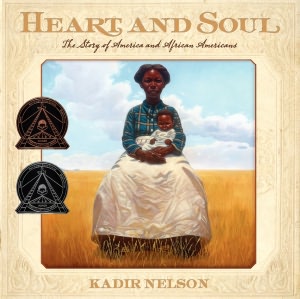
Heart and Soul: The Story of America and African Americans

Heart and Soul: The Story of America and African Americans
By: Kadir Nelson
Published by: Balzer + Bray
Coretta Scott King Book Award 2012: Author Winner & Illustrator Honor
Informational
 
 
This story, written and illustrated by Kadir Nelson, tells the story of African Americans in America. Much like a timeline, the story follows the life and roles in society of African Americans from the beginning of our country. The story is told from the point of view of an African American woman who's ancestors can be traced back many generations in this country. Through the many different times of hardship and injustice, readers can also read and learn about the undying determination of African Americans in this country for their freedom and equality. As much as it is a historical reference, the story is also a tale of hope and inspiration.

Reading Level:
     Grade Level Equivalent: 6.0
     Lexile Level: 1050

Suggested Delivery:
     Individual Read, Small Group Read

Electronic Resources:

http://www.kadirnelson.com/Books.html
This is the personal website of the author and illustrator of the book. There are tabs on the page to a store, his commisioned artwork, books, about the artist and news. Students can even contact the author and illustrator if they wish. This site could be used before reading to learn more about the author and his background.
http://www.harpercollinschildrens.com/books/Heart-Soul-Kadir-Nelson/?isbn13=9780061730740&tctid=120
This is a page from the publishing company about the book. There is a downloadable audio excerpt, as well as a video, a note from the author, a teacher's guide and a look at Nelson's artwork. This site could be used before reading to get some background information about the book. It could also be used during or after reading in order to enhance the story using the audio or video downloads.

Key Vocabulary:
lynch, Jim Crow, Mason Dixon Line, factory porters, suffrage, draft, Emancipation Proclamation

Comprehension Strategies:

Before Reading:
This book would accompany a Social Studies lesson during black history month very well. Before reading this story, have student fill out a K-W-L chart, either in pairs or on their own. Obviously before reading the story, students can only fill in the "K" and "W" columns. If you have been studying the topic in your class recently, students will have an easier time filling in the "K" column, otherwise there might be more questions they want answered in the "W" column.

During Reading:
Have students use the questions they had about the story to guide their reading. After students have come up with their "want to knows" about the story, type them up into question form to hand out to each student. As they read, students will be like detectives trying to find the answers.

After Reading:
Since students have been answering all of their questions along the way, filling in the "L" column on the chart should be fairly simple. Using all they learned, students can make a timeline with the important events from the story. Since this is a true historical timeline, they could be hung up in the classroom to reference back to during Social Studies lessons.


Writing Activity:
Have students write a letter to Abraham Lincoln during the war. Students can choose what side they want to be on and then encourage the President to take their side. Have them use specific details from the story.


Nelson, Kadir. Heart and soul: the story of America and African Americans. New York: Balzer + Bray, 2011. Print.


Thursday, August 16, 2012

Nurse, Soldier, Spy: The Story of Sarah Edmonds, a Civil War Hero

Nurse, Soldier, Spy: The Story of Sarah Edmonds, a Civil War Hero
By: Marissa Moss & John Hendrix
Published by: Abrams Books for Young Readers
Teachers' Choice List 2012
Biography


In this historical biography we learn about Sarah Edmonds who changes her identity to a man named Frank Thompson to fight for the Union in the Civil War. Sarah Edmonds had already been dressing as a man for three years to escape an arranged marriage, so this would be easy. She signed up and was assigned to Company F, Second Michigan Volunteer Infantry of the Army of the Potomac. First, Sarah was a private in the army, fighting alongside the other men in the ar. Then, Sarah became a nurse in the field, pulling injured men out of the war zone and healing their wounds. However, the most important job Sarah had was a spy for the Union. She dressed as a slave and went into a Confederate camp to learn their tactics. After working with the slaves for a few days, she went back to her camp and reported what she had found. She, a woman, had just done one of the hardest jobs in the war, and still everyone thought she was a man!

 Reading Level:
     Grade Level: 2-6

Suggested Delivery:
     Read Aloud

Electronic Resources:
http://www.californiayoungreadermedal.org/ResourceGuide2012-2013/6PBOR.pdf
This link brings you to a PDF full of ideas and activities for this story. The info in this PDF would be helpful to teachers teaching this book. There is info about the author and the illustrator, along with a plot summary, hooks for the class, connections to be made and a script for a readers' theater. There is also a list of writing prompts to go along with the story.
http://womenshistory.about.com/od/civilwar/a/sarah_edmonds.htm
This site gives a little more background information about Sarah Edmonds. The biography gives her birth and death dates, along with a brief summary of her life.
http://womenshistory.about.com/gi/o.htm?zi=1/XJ&zTi=1&sdn=womenshistory&cdn=education&tm=22&gps=82_4_1280_651&f=10&tt=14&bt=0&bts=0&st=24&zu=http%3A//userpages.aug.com/captbarb/femvets2.html
Obviously, Sarah Edmonds' involvement in the war was unconventional for a woman, but women were still involved in other ways. This site gives many famous examples of women who were involved in the Civil War.
http://www2.lhric.org/pocantico/civilwar/cwar.htm
This site is all about the Civil War. The site was made by a class in New York who was learning about the Civil War as well. Before reading this story, it is important for students to understand at least the basic facts about the war. This site has a timeline, the north and south informations, the Gettysburg Address, the Emancipation Proclomation and more!

Key Vocabulary:
Minie ball, anesthetic, Confederate, The Union, dolt, picket, forifications, sentries


Comprehension Strategies:

 
Before Reading:
Going over some of the harder vocabulary from the story will ensue a quick history lesson about the Civil War. Having some background knowledge about the Civil War is important for students to understand what is going on in the story. Post all of the Civil War related words on the board to begin a discussion about the words. Have students share their knowledge of each word to try to 'decode' the meanings. Introducing the story will be easier now by explaining to the students that the story is of an unconventional soldier in the war.
 
During Reading:
While reading the story aloud to students, have students try to put themselves in Sarah's shoes. What do they think it was like to be a girl in an all male army? What pride do they think she must have felt when she succeeded on her spy mission?

After Reading:
After reading students can discuss how difficult it must have been for her and how they felt, imagining themselves in her position. After getting to hear one experience of a soldier in the Civil War, the class can read a play together in reader's theatre to emphasize the importance and different view points of the war. The following link includes a play with a basic plot about the Civil War. http://www.civilwar.org/education/teachers/lesson-plans/civil-war-play/civil-war-play-lesson-plan.html

Writing Activity:
Have students think about the emotions Sarah Edmonds must have felt in her experiences during the Civil War. Have students write a journal entry as if they were Sarah, with details from the story.

 
Moss, Marissa, and John Hendrix. Nurse, soldier, spy: the story of Sarah Edmonds, a Civil War hero. New York: Abrams Books for Young Readers, 2011. Print.

Tuesday, August 14, 2012

Energy Island: How One Community Harnessed the Wind and Changed Their World

Energy Island
By: Allan Drummond
Published by: Farrar Strauss Giroux
Teachers' Choice List 2012
Science Nonfiction

On a small island in Denmark called Samso, lives a group of people who found a way to create their own energy. The island was using energy like everyone else in the world: oil for houses and cars, and electricity for lights. Soon this would change when the Danish Ministry of Environment and Energy chose the island to become independent of nonrenewable energy. The people on the island all worked together to come up with ways to create their own energy. Of course because the island was so windy, the number one way they did was through wind turbines. Sometimes the island harnesses enough wind to send some back to the mainland in Denmark!

This book is a real life story to show children how important and fragile our world is. Throughout the book, there are side columns explaining things like nonrenewable resources and global warming. This would be a great choice for Earth Day or to learn about helping our planet.


Reading Level:
     Grade Level: 1-5

Suggested Delivery:
     Read Aloud, Individual Read


Electronic Resources:
http://www.alliantenergykids.com/EnergyandTheEnvironment/RenewableEnergy/index.htm
This site gives definitions and examples of all different kinds of renewable energy sources. Many were mentioned in the book, like wind, biomass and solar. There is a link to 'Fun and Games' where students can "test their energy smarts" or find projects to try at home. This site would be a good way for students to look at the information from the story in a different light and maybe even apply what they learned in a practical way.
http://www.allandrummond.com/
This is the author, Allan Drummond's personal website. He writes about the different books he has written and is currently working on. He also has links to his portfolio and a biography section. This would be a nice site for students to learn a little more about the author.
http://www.kids.esdb.bg/basic.html
This is another informational site for students with facts about all different kinds of energy. There are sections about what energy is and the different places it can come from. There is also a games tab and a tab titled "New Energy" which gives information about the types of energy from the story.
http://us.macmillan.com/FSGYoungReaders.aspx
This is the website for the publisher of the book. The site has many tabs for their books and authors, as well as a link for teachers and librarians.

Key Vocabulary:
energy, nonrenewable energy, energy-independent, renewable energy, turbine, biomass, canola, fossil fuels, global warming

Comprehension Strategies:
Before Reading:
Doing a vocabulary lesson before reading the story would be helpful to students' comprehension because the new vocabulary words are content specific to energy. The vocabulary list above gives a good sample of the "energy" words from the story. Have the class sit together and simply discuss what they think these words might mean. Some are harder concepts than others, but the teacher can help explain these harder words, while with the easier concepts, students will be able to generally explain.

During Reading:
While reading the story aloud to the class, making sure everyone is understanding these new concepts in context is important. Encourage students to raise their hand at any point if they do not understand a concept. By stopping the story to explain, it will allow that student to understand, while also reinforcing the idea with the rest of the class.

After Reading:
After reading the story, have students predict what will happen next. Will the rest of the world try to use renewable resources like the island did? Why do you think we haven't done such extreme projects in our town? (Cost?)

Writing Activity:
Have students use their imaginations to apply this idea to their community. Write about how their community could use renewable resources instead of oil and gas. Have students write their plan for how the community would switch over and how they would convince citizens of the town to agree to it.

Drummond, Allan. Energy island: how one community harnessed the wind and changed their world. New York: Farrar, Straus and Giroux, 2011. Print.